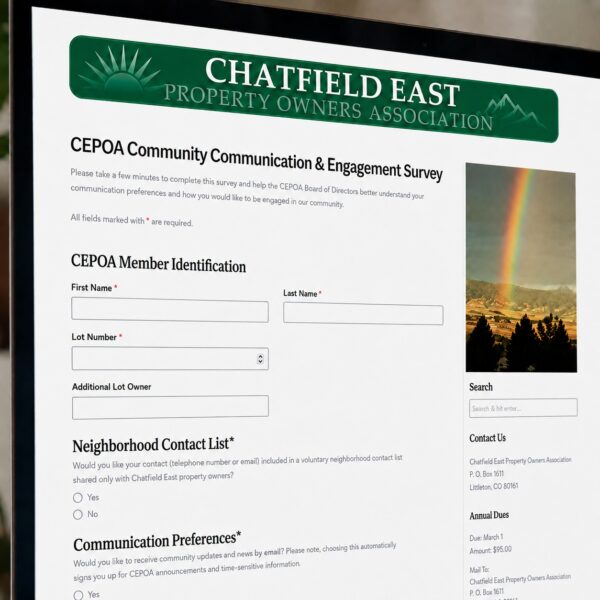
In early 2026, the CEPOA board distributed a community survey described as an informal, voluntary tool to “gather general feedback.” The intent, according to board president Russell, was to help the board “understand areas where members may have interest in volunteer activities, communication improvements, or community initiatives.”
What followed was a two-month exchange that raises serious questions about the board’s commitment to transparency — and about whether a survey that reached fewer than half of all homeowners should be used to shape association priorities at all.
The Numbers the Board Didn’t Emphasize
Of CEPOA’s 103 lots, 44 unique households responded to the survey — a 43% response rate. That means 59 households, representing 57% of the community, did not participate.
At the March 17 board meeting, those participation figures were mentioned once, at the outset. Every result that followed was presented exclusively as a percentage of respondents: “87% said…”, “half the people said…”, “76% rated…”, “95% said…” The 59 non-participating households — the majority of the community — vanished from the narrative entirely.
“When governing documents require supermajority approval for certain actions, non-participating lots are treated as ‘no’ votes to protect the entire community from decisions driven by a small subset of owners.”
— Homeowner Mark Hochstedler, in written correspondence to the board, April 21, 2026A homeowner, Mark Hochstedler, raised this concern in writing before the results were even presented — asking in February how participation would be reported, how non-respondents would be treated, and whether results would be weighted by lot. He received a written response from the board president on March 11 containing what appeared to be clear commitments.
Promises Made. Promises Not Kept.
What the Numbers Actually Show
Hochstedler compiled a side-by-side comparison showing what the board’s reported figures look like when calculated against all 103 lots rather than just the 44 who responded. The difference is significant.
| Survey Finding | As Reported by Board (% of 44 respondents) |
Adjusted for Full Community (% of 103 lots) |
|---|---|---|
| “87% support electronic communications” | 87%~38 of 44 respondents | ~37%37 of 103 lots |
| “95% satisfied with current services” | 95%~42 of 44 respondents | ~41%42 of 103 lots |
| “76% interested in entrance improvements” | 76%~33 of 44 respondents | ~32%33 of 103 lots |
| “Half interested in community clean-up” | 50%~22 of 44 respondents | ~21%22 of 103 lots |
Beyond the participation problem, Hochstedler noted that the survey platform explicitly allowed multiple responses from a single household — and the board acknowledged at the March 17 meeting that some households submitted twice. The board’s response: because the survey is “advisory only,” individual responses rather than lot-weighted responses were acceptable.
He also flagged a leading question embedded in the survey itself: respondents were asked whether they wanted to receive communications electronically, with the note that “choosing this dramatically helps the CEPOA communicate efficiently while keeping costs down.” No option was provided to receive some communications electronically and others by mail. The question, as written, nudged respondents toward a specific answer.
The Statistical Reality
In a closed population of 103 lots, basic survey methodology establishes clear thresholds for defensible results. A ±5% margin of error — the standard for credible community surveys — would require 82 responses, or a 79.6% response rate. Even a generous ±10% margin of error requires 50 responses, a 48.5% response rate.
CEPOA’s survey drew 44 unique responses. That produces an actual margin of error of approximately ±11.2% at 95% confidence. In plain terms: nearly every finding reported at the March 17 meeting could be 10 to 12 percentage points lower across the actual community — and the board would have no way of knowing.
The board is entitled to gather informal community input. What it is not entitled to do is present that input as evidence of community-wide preference when it represents fewer than half of all homeowners — especially when the board made explicit written commitments to contextual reporting and then did not follow through. These results were used to shape board priorities on communications, newsletters, ACC recruitment, and entrance improvements. Homeowners who did not respond had no voice in that process, and were never told that their silence would be treated as irrelevant.
The Response: Acknowledged, Then Dismissed
Hochstedler raised his concerns in writing three times: first in February before results were presented, then again in April after reviewing the March 17 meeting, and through the board’s own reply chain. His concerns were detailed, documented, and — by any measure — substantive.
The board’s final response, dated April 23, 2026, ran four short paragraphs. It acknowledged that reporting respondent-only percentages “without consistent reference to overall participation” was “fair feedback.” It then stated that the board would “try and keep things general” in future summaries, offered no commitment to retroactively clarify the March 17 results, and declined each of Hochstedler’s three specific requests — for full-lot denominators in future presentations, publication of open-ended response themes with supporting counts, and adoption of neutral question wording in future surveys.
No explanation was given for why those requests were declined. The email closed with: “I think with that framing, it met its purpose.”
“I am going to try and keep things general.”
— CEPOA Board President Russell, April 23, 2026, in response to a homeowner’s documented request for transparent survey reportingTimeline
- February 22, 2026 Homeowner submits detailed written questions to the board before survey results are consolidated, asking about participation weighting, reporting methodology, and use of results.
- March 11, 2026 Board president responds with written commitments: participation levels will be visible relative to total lots; non-participation will not be interpreted as yes or no.
- March 17, 2026 — Board Meeting Survey results are presented. The 103-lot denominator is stated once, then dropped. All results reported as respondent-only percentages. Results cited as basis for board priorities including ACC recruitment, communications changes, and entrance improvements.
- April 21, 2026 Homeowner documents the discrepancy between the board’s written commitments and the March 17 presentation. Provides side-by-side data table, margin-of-error analysis, and three specific corrective requests.
- April 23, 2026 Board president responds. Acknowledges the concern is “fair feedback.” Declines all three corrective requests. Offers no commitment to retroactive clarification. Closes the matter.
- May 17, 2026 Homeowner follows up again after no corrective action was taken. Board president replies that the survey was simply “one of many informal inputs” and that the board does not plan to provide additional statistical summaries.
- May 18, 2026 — Homeowner Reply Homeowner states he is not willing to drop the issue, cites a pattern of murky surveys being used to manufacture the appearance of community support, and notes the board cannot use respondent-only percentages to justify priorities while simultaneously calling the survey informal when questioned.
- May 18, 2026 — Board President Final Reply Board president declares an impasse and asks the homeowner to provide his lawyer’s name so the two lawyers can speak. The homeowner had not threatened legal action at any point in the exchange.
Update: The Board Ends the Conversation
The exchange did not end with the April 23 response. The homeowner followed up again in May, noting that the board could not have it both ways: citing respondent-only percentages as evidence of community preference during the March 17 meeting, then retreating to “it was only advisory and informal” when those percentages were questioned.
The board president’s May 17 reply acknowledged the concern about how results were referenced but restated that the survey was one of many inputs and that no additional statistical reporting would be provided.
On May 18, the homeowner replied that he was not willing to drop the matter. He offered his 30 years of property management experience and said he wanted to be a constructive contributor to the community. He asked a direct question: if the board does not want detailed feedback on governance, how would it prefer members raise serious concerns?
The board president’s response that same morning contained no answer to that question. Instead, it read:
“We are at an impasse. Would you like to escalate this legally? If so, please let me know your lawyer’s name and we can have our two lawyers talk to each other. But at this point, more discussion between you and I will not result in a different outcome.”
— CEPOA Board President Russell, May 18, 2026The homeowner had not threatened legal action at any point in the exchange. He had not filed a complaint. He had not contacted an attorney. He had asked, in writing and in detail, whether the board would correct the public record on a survey it used to shape association priorities. The board’s answer, after nearly three months of correspondence, was to treat the question as the start of a legal dispute.
The homeowner’s final reply was measured. He said he did not believe he needed a lawyer. He reiterated his good intentions and his offer to contribute his professional experience. He noted that the pattern he described — using informal surveys and straw polls to create the appearance of broader consensus — was one he had seen before, and that was precisely why he had pressed the issue.
What Homeowners Should Know
The survey results as presented at the March 17 meeting remain in the public record without correction or context. The board has stated in writing that it does not plan to provide additional statistical summaries or publish the open-ended response themes. When a homeowner spent three months asking it to reconsider, the response was a referral to legal counsel.
CEPOAWatch has reviewed the full email exchange. The concerns raised are detailed, documented, and unrefuted on the merits. We will continue to track how these survey results are used in future board deliberations and whether the board’s stated preference for “keeping things general” extends to other community communications.
Homeowners who wish to review the original survey, the board’s written commitments, or the full email exchange may submit a records inspection request in writing to the board. Under Colorado law (Section 38-33.3-209.5), the association is required to respond.