The Deal You Made
When you purchased your lot in Chatfield East, you accepted the recorded covenants. That is not a formality. The Amended and Restated Declaration of the Protective Covenants runs with the land. It binds every lot, every sale, every owner who comes after you. What most buyers do not read carefully is that the covenants cut in both directions. You gave up certain freedoms: you need approval before you build a fence, put up a barn, or remodel the exterior of your home. In exchange, you received something: a set of rules that binds the committee reviewing your application just as much as it binds you.
Those protections include a hard deadline. They include a self-executing remedy if the committee misses it. They include a clear statement of who has authority to approve your plans. And they include a recorded promise, in the Statement of Values, that the covenants are meant to impose minimal intrusion in your pursuit of happiness and are not meant to duplicate local, state, or federal laws.
I went through the proposed ACC v2.0 draft, dated March 24, 2026, line by line against the recorded Declaration, the Bylaws, and the 2024 guidelines currently in effect. I did not want to find what I found. What follows is a section-by-section account of what the draft changes and what each change would mean for you the next time you pick up the phone to ask about a project.
The draft has not been adopted. Board president Russell Ziegler paused the vote at the April 21, 2026 board meeting and said the document needs further revision and community input. That makes right now the time to understand it.
Section 1: Your 30-Day Approval Right: What the Proposed ACC Guidelines Take Away
2024 Guidelines: “The ACC will review the initial submissions and provide written comments or requests for revision via e-mail typically within 15 days of the complete submission of the materials listed above but it may take longer. If a revision to the plans is requested, the ACC will review the revision within 15 days of the revised submission.”
v2.0 Draft: “The website and application process should guide owners through the submission process and make clear that the review clock begins only once a complete application has been received.” Complete Application: “An application that includes all required forms, drawings, materials, descriptions, and supporting items applicable to the project type, or any additional items specifically requested by the ACC.”
The Declaration’s protection on this point is clear. No building or fence may go up until the ACC approves your plans. Then comes the sentence that works in your favor:
“In the event the Committee or its designated representative fails to approve or disapprove within thirty (30) days after plans and specifications and plot plan have been submitted, or in the event no suit to enjoin the construction has been commenced prior to the completion thereof, approval will not be required and related covenants shall be deemed to have been fully complied with.”
This sentence sets the ACC’s deadline and the consequence for missing it.
The clock starts at submission. If the ACC does not act within 30 days, the owner wins by default. Delay costs the committee, not the homeowner.
The v2.0 draft reverses that. The Declaration already defines what a complete submission looks like: plans, specifications, and a plot plan. That package starts the clock. The draft replaces that definition with its own. A “Complete Application” under the draft is one that includes all required items for the project type, “or any additional items specifically requested by the ACC,” and Section 4 states that “the review clock begins only once a complete application has been received.” The Declaration’s defined package has been swapped for an open-ended standard the ACC controls.
Under the Declaration, the clock starts when you submit. Under the draft, it starts when the ACC says your submission is complete, which includes anything the committee decides to ask for along the way. The 2024 guidelines committed the ACC to written comments within 15 days and gave you 270 days to finish an approved project. Both commitments are gone from the draft with nothing replacing them. The one deadline that survives in the draft, the 90-day appeal window, runs against you, not the committee.
At the April 21 meeting, board member Ryan Edwards addressed the 30-day question directly. There is “some ambiguity,” he said: there are 30 days to approve something, but submitting “your name on a piece of paper” and a statement of intent “doesn’t constitute a submittal.” That is a fair description of the problem the ACC faces with thin applications. It is also precisely the question the draft resolves in one direction. The Declaration starts the clock at submission of plans, specifications, and a plot plan, a defined package. The draft starts it when the ACC says so.
Edwards’s “name on a piece of paper” example actually argues for better submission clarity and a defined ACC submission standard, one that specifies what a complete application requires and gives the committee clear authority to deny anything that falls short. The Declaration already gives the ACC that remedy: deny the incomplete application and state the reason. That authority exists independent of the 30-day clock. The draft reaches past that remedy and removes the clock protection instead.
What this means for you: the next time you submit an application, the Declaration’s protection is in place only if the clock starts at submission. The draft’s subjective completeness definition means it may not. A committee that takes its time defining what it needs from you is not missing a deadline, it is holding the start line.
Section 2: Your Application Just Got Longer. The Review Did Not.
2024 Guidelines: “Depending on the project, the ACC may request an on-site visit.”
v2.0 Draft: “For larger projects and fencing, the ACC may require a pre-construction layout inspection once the footprint or fence line is staked so location and basic dimensions can be checked before major costs are incurred.”
The 2024 guidelines required a site plan, exterior elevations, floor plans, a roof plan, material descriptions, and a Douglas County drainage plan where applicable. The v2.0 draft organizes submission requirements by project type, which is a genuine improvement in clarity. But it also expands what the ACC may require, including a neighbor communication summary, described in Section 3 below, and adds a tiered inspection process that does not exist in the Declaration.
The Declaration requires approval of plans. It does not require staking inspections, pre-construction footprint reviews, or post-construction conformance checks. The draft adds all three as things the ACC “may require.” The 2024 guidelines said the ACC may request an on-site visit depending on the project. That discretion already existed. The draft formalizes it into a tiered regime and adds a post-construction walkthrough the current guidelines do not contain.
What this means for you: a longer checklist before your clock starts, a process that may include multiple site visits the Declaration does not require, and a review timeline that has no floor.
Section 3: Your Neighbor Is Now Part of Your Application
2024 Guidelines: “Including a written statement from your neighbors in support of your project will help to expedite ACC approval.”
v2.0 Draft: “Applicants are strongly encouraged to speak with neighbors who may reasonably be affected by a proposed project, particularly where placement, scale, height, lighting, fencing, or view impacts may be involved. The application should provide a short summary of which neighbors were contacted and any feedback received. This is intended to improve communication and help the ACC understand issues early; it does not give neighbors veto power over a project. The ACC may follow up with neighbors when it believes a project may materially affect adjacent lots or neighborhood view corridors.”
Under the current guidelines, a supporting word from your neighbor is optional. The 2024 guidelines say “including a written statement from your neighbors in support of your project will help to expedite ACC approval.” Optional, and to your benefit if you choose it.
The v2.0 draft turns that around. Applicants are “strongly encouraged to speak with neighbors,” the application “should provide a short summary of which neighbors were contacted and any feedback received,” and “the ACC may follow up with neighbors when it believes a project may materially affect adjacent lots.” What was an optional letter in your favor becomes a reporting requirement, with the committee empowered to go ask your neighbors directly.
The draft anticipates the obvious objection and tries to head it off. It says the summary “does not give neighbors veto power over a project.” But look at what the same passage does. It creates a channel for neighbor influence, gives the ACC discretion to act on it, and then assures everyone it isn’t a veto. Those things are in tension. A provision that has to promise it isn’t a veto is one that creates enough neighbor influence to make the promise necessary. A homeowner reading it cannot tell how much a neighbor’s objection will actually count. The draft says neighbor feedback isn’t a veto, yet it presses you to go collect that feedback and hand it in. If it truly didn’t count, there would be no reason to require the errand. You either need the neighbor’s blessing or you don’t. The draft wants it both ways.
The draft is candid about what it wants. The neighbor summary, it says, is “intended to improve communication and help the ACC understand issues early.” Understand which issues? Issues between neighbors. But neighbor disputes are civil matters. The Declaration’s Statement of Values places them outside the association’s role and says CEPOA “is not meant to be an enforcement agent” in disagreements between owners. The draft states, as its own purpose, a desire to bring the committee into exactly the disputes the covenants told it to stay out of. Neighbor issues are not the ACC’s business. The draft’s own words say it wants them anyway.
What happens when two neighbors don’t get along?
Every homeowner can picture it. The neighbor you wave to, and the one you don’t. Under the draft, your application now asks who you talked to and what they said. But the draft never answers the question it raises. What happens when the neighbor won’t talk to you? When the feedback is hostile for reasons that have nothing to do with your fence? When the person the ACC follows up with has a grudge older than the project? The draft builds a process that depends on neighborly goodwill and provides nothing for the many cases where that goodwill does not exist. It assumes the best version of every neighbor relationship, on paper, in a community made of real ones.
The draft states the neighbor communication summary “does not give neighbors veto power over a project.”
The same draft directs applicants to report which neighbors were contacted and what feedback they gave, and authorizes the ACC to follow up with neighbors directly. Neighbor input is collected, and the committee is empowered to act on it.
The Statement of Values keeps neighbor disputes outside the association’s role. The draft brings them in, then promises the input it just invited will not be decisive. A homeowner cannot tell, from the draft, how much a neighbor’s objection will actually count.
What this means for you. Your approval should turn on whether your plans meet the standards in the governing documents. Under the draft, it may also turn on a variable you cannot control and the committee cannot compel: whether your neighbor chooses to cooperate.
Section 4: Who Actually Approves Your Plans
Declaration, Paragraph 2: The ACC “has the task of reviewing and approving/rejecting all plans for all improvements (new or remodeled dwellings and outbuildings) to be constructed on each Chatfield East lot.”
v2.0 Draft: The ACC “is responsible for reviewing and making recommendations on applications.” Routine approvals are “presented to the Board.”
When you submit an application, you are entitled to know who decides it.
Start with what the board has on its side, because the Declaration does give it real authority over the committee. The same paragraph that creates the ACC says the committee “is subject to the direction of the Board and must report to the Board as and when directed to do so.” The board appoints ACC members, sets their terms, and may remove them “at any time, for any reason or no reason.” The Declaration also states that “ACC Guidelines and any updates must be officially adopted by the Board through a formal vote.” So the board supervises the committee, staffs it, and adopts its guidelines. None of that is in dispute.
What the board does not have is the approval itself.
The Declaration gives the ACC one task, stated plainly: reviewing and approving or rejecting plans. Supervising a committee is not the same as taking over its function. A board that can direct, appoint, and remove is still a board whose committee holds the decision, and the Declaration says who holds this one.
The Bylaws draw the same line from the other direction.
Read that carefully. The Bylaws describe “action to be taken by the Architectural Control Committee,” and they specifically deny the board’s own representative a vote on it. That only makes sense if the action belongs to the committee. If approvals were the board’s to give, there would be nothing for the liaison to be excluded from.
The draft rearranges this. The ACC becomes a body that reviews and makes recommendations. Approvals get “presented to the Board.” The task the Declaration assigned to the committee lands somewhere else.
That rearrangement has a consequence the draft never addresses. The 2024 guidelines give you ninety days to appeal a denial to the board. That right assumes the board is somewhere else to go. If the board is the body granting or withholding approval in the first place, an appeal to the board is an appeal to the same people who just decided. The current process gives owners a second look. The draft’s structure would leave you asking the deciding body to reconsider itself.
Where the deliberation happens.
There is a second problem, and it runs into the Bylaws again. Section 6.10 requires that all regular and special meetings of any committee of the Association, “including the Architectural Control Committee,” be open to attendance by all members.
The draft’s recommended workflow assigns one ACC member as the project owner for each application. That member gathers input from the other members and communicates with the applicant, with substantive communication happening by email. If the committee’s position forms through one member polling the others electronically, the deliberation the Bylaws open to every member happens where no member can attend.
At the April 21 meeting, Ziegler described the actual practice, and it matches the Bylaws rather than the draft. Even when the ACC responds to an application right away, he said, the committee “can’t approve until the ACC comes onto the board meeting,” because “they need to do it in a public meeting.” That is the Bylaws working as written. The draft’s workflow is not.
Teri Hochstedler, a former board president, raised the underlying limit at the same meeting. Guidelines “can never take away rights that are granted in the covenants,” she said. Guidelines exist to clarify, “but you can’t make more rules. You can’t take away people’s rights in doing that.” She told the meeting she was “deeply disturbed” by provisions in the draft that she said violated CCIOA and the covenants, and warned that if a vote on guidelines is not conducted properly, “none of us have to do anything because it was a completely bogus thing.”
What this means for you.
The board can supervise the ACC. It appoints the members, directs the committee, and adopts the guidelines. That authority is in the Declaration and nobody disputes it.
What the Declaration does not do is hand the board your approval. It gives that to the ACC in one sentence, and the Bylaws build a structure around the committee taking its own actions in meetings you are entitled to attend.
The difference matters most at the moment you need it. Under the current guidelines, a denial from the ACC can be appealed to the board within ninety days. Under the draft, if the board is the one approving, that appeal has no independent place to land.
Section 5: The Loophole Nobody Will Name
2024 Guidelines: “An outbuilding is defined as any structure that is separate from but associated with a main residence and is greater than 25 square feet that has at least 3 enclosed walls, a door/opening, and a roof.”
v2.0 Draft: “”Any permanent structure, or portion thereof, built for the shelter or enclosure of human beings, animals, vehicles, equipment, or property of any kind, excluding signs and fences. A structure may be considered a building regardless of the number of walls or whether one or more sides are open.”
The board says the rewrite closes a loophole. The comparison summary says the changes close “loophole arguments.” That is their justification. The question is: what was the loophole?
The summary never says.
It just says a loophole existed and the draft closes it. It does not identify who used it, when, or how. The closest the documents come to explaining the loophole is the outbuilding definition. The 2024 guidelines said an outbuilding was over 25 square feet with at least three walls, a door opening, and a roof. A structure that missed any of those did not meet the definition. That is the only loophole the documents point to: someone could argue an open-sided structure was not an outbuilding, and so fell outside ACC purview. The draft closes it by pulling in almost any roofed structure that shelters or stores. Why?
Fine. Say that is the loophole. A definition problem gets a definition fix. Remove the wall requirement, and the argument is gone.
But then look at what else the draft does in the name of closing it.
It adds inspections during construction. Staked footprint reviews before you build, conformance checks as you go. What does an inspection during construction have to do with the definition of a building? Nothing. You decide whether a structure is an outbuilding by reading the definition, on paper, at application. An inspection three weeks into construction does not answer a definition question. It answers a different question entirely: is what you are building what was approved.
So the board offers one reason, a definition loophole, and then builds a draft where most of the new machinery has nothing to do with definitions. The stated reason explains a sliver of what the draft does. The rest is unexplained. Inspections, completeness gates, a redefined approval structure: none of it follows from closing a definition loophole. The justification and the document do not match.
And here is the part worth sitting with. The entire rewrite is sold as creating clarity. The board said so at the April 21 meeting, more than once. Yet the one thing the board never makes clear is the problem it is solving. It uses an undefined purpose to justify a clarity project. The reason for the clarity is itself unclear.
The board says the draft closes a loophole. It never says what the loophole is. If the loophole is the definition of a building, what are the inspections, the deviation rules, and the completeness gate doing there?
One thing worth granting. The draft is better organized than what it replaces. It sorts projects by type, tells you which materials go with which application, and puts the review process in one place. Anyone who has hunted through the 2024 guidelines for the fencing rules will find the draft easier to navigate. The structure improved.
The substance went the other way.
There is one more thing to notice about that definition, and it points somewhere the board did not mention. The draft’s definition of a building is not original. It is taken, nearly word for word, from the Douglas County Zoning Resolution, the county code that already governs these lots. The county’s definition reads: “Any permanent structure, or portion thereof, built for the shelter or enclosure of human beings, animals, or property of any kind and excluding signs or fences.” The draft copied it, added “vehicles, equipment” to the list, and tacked on the wall-count sentence. The association did not write a definition to fill a gap. It borrowed one the county already applies to the same properties.
clarify, verb: to make something clearer or easier to understand.
expand, verb: to increase in extent, number, or scope.
The draft borrows Douglas County’s definition of a building and applies it to structures the guidelines did not reach before. That is the second word. The board keeps using the first. The covenants have something to say about duplicating what the county already does. We take that up in Section 7.
What this means for you.
Set aside the loophole nobody will name. Look at what the definition change actually does to you.
The covenants control what sits on your lot by counting. Covenant 1 permits one dwelling and no more than two outbuildings. It gives examples, a detached garage, a barn or shed for horses, a pool house, a greenhouse, a garden or tool shed, but the operative control is the number. Two. You can count your own buildings.
The draft controls it by taxonomy: by sorting each structure into a category. And the categories are broad.
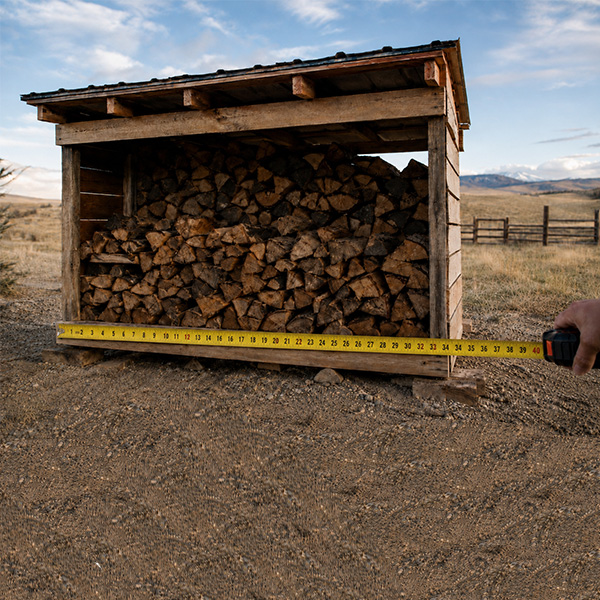
Take a roofed firewood rack against the side of your barn. Thirty square feet, open on three sides. Under the 2024 guidelines you could settle it yourself, standing in your driveway with a tape measure. Three enclosed walls? No. Then it is not an outbuilding. It does not count against your two and it does not need approval.
Under the draft, read the words that decide it. The definition covers structures built for the shelter or enclosure of “property of any kind,” and an outbuilding is anything that “functions as a shelter, storage, or enclosure structure.” Firewood is property. A rack that holds it is storage. It is over twenty-five square feet, so the draft presumes it is an outbuilding. You do not have to guess at that. The definition is plain. It now covers a firewood rack.
Now take a carport attached to your garage. It has no enclosed walls, so under the 2024 test it was not an outbuilding. The draft’s definition names “vehicles” among the things a building shelters and says wall count does not matter. Also plain. It now covers a carport.
Same structures. Same lot. What changed is that both are now inside the rules, and both now count against your two.
Where the draft does leave room for judgment, it leaves it at the edges. “Permanence” appears in the definition and is never defined. And structures under twenty-five square feet can still be treated as outbuildings when the committee decides their “design, permanence, or use” warrants it. So the small things are discretionary and the larger things are simply captured.
The line that used to sit at three walls now sits at a roof.
The board clarified the 2024 guidelines by taking control of nearly every structure you might put on your lot. They want to decide for you.
Section 6: Rules That Appeared and Disappeared Without Notice
2024 Guidelines: “A segment of privacy fence must be no more than 40 linear feet in length if not enclosing an area, nor should the entire fenced area enclose an area more than 5000 square feet.”
v2.0 Draft: The draft keeps the privacy fence rules but removes the 40-foot segment limit and the 5,000 square foot enclosure cap. No numeric size limit replaces them.
The board provided a comparison document, the Old vs. New Summary, to help members see what changed. Its stated purpose is to help members “quickly see how the guidelines are changing.” Several changes do not appear in it.
| The Change | In the Summary | What the Documents Show |
|---|---|---|
| 15-day review commitment removed | Not mentioned | 2024 guidelines: written comments “typically within 15 days.” Draft: no review timeline of any kind. |
| Declaration’s deemed-approval protection affected | Not mentioned | Declaration ties the 30-day clock to submission; draft ties it to ACC-determined completeness. |
| Headlight-screening requirement added | Not mentioned | Draft Section 8.7 requires driveway design or screening via “landscaping, berming, hardscaping, or a combination thereof.” No counterpart in the 2024 guidelines or Declaration. (The covenants do not give them this authority.) |
| Fence and dog-run size limits removed | Not mentioned | The draft keeps the fence and dog-run rules but drops three numeric limits: the 40-foot privacy fence segment, the 5,000 sq. ft. enclosure cap, and the 30-foot dog-run distance. No numeric limit replaces them. |
| ACC role redescribed | Not mentioned | Declaration: ACC approves/rejects. Draft: ACC reviews and makes recommendations presented to the board. |
The summary is not a neutral map of the changes. Take the most consequential one. In the same row, the summary notes that “review timing starts when complete,” and calls the change “easier for owners and easier for the ACC to administer.” Read those together. The provision that lets the committee decide when your 30-day clock starts is presented to you as a convenience. That is not a summary leaving something out. It is a summary describing a restriction as a benefit. The pattern holds across the document: the changes that tidy are foregrounded, the ones that shift power between you and the committee are softened or skipped.
One row in the summary is worth noting for its candor. The outbuilding measurement change is described as reducing disputes “until the Declaration itself can be amended.” That acknowledgment places the concept’s proper home in the Declaration, which only a vote of 60 percent of owners can change under Paragraph 23. The summary concedes that a guideline is doing work that belongs in a document only the membership can authorize.
The Old vs. New Summary discloses its own limits, noting it was prepared “ONLY as an aid” and urging members to read both documents. That is fair. But a summary that omits every change running against the ACC’s accountability, while describing itself as helping you see what changed, creates a specific problem: a member who read only the summary would have no reason to look for the deleted deadlines, the softened reapproval rule, or the redescribed approval authority. The invitation to read both documents is honest. The gap between that invitation and what the summary prepares you to look for is not.
Section 7: What This Community Was Built To Be
Statement of Values, adopted by the owners in 2022: The covenants “are not meant to duplicate local, State or Federal laws… The owners value living within nature and seek to maintain this rural way of life while ensuring minimal intrusion in their pursuit of happiness.”
v2.0 Draft: “Any permanent structure, or portion thereof, built for the shelter or enclosure of human beings, animals, vehicles, equipment, or property of any kind… A structure may be considered a building regardless of the number of walls or whether one or more sides are open.”
Chatfield East is zoned rural residential. That category exists for a reason. Lots measured in acres, with barns and sheds and equipment on them, are meant to be governed more lightly than a subdivision of quarter-acre lots. The zoning is a promise about what kind of place this is.
The covenants keep that promise, and you can see it in how little they say. One dwelling. No more than two outbuildings. Setbacks of seventy-five feet from the front line and forty from the sides and rear. A range of allowed house sizes. A committee with thirty days to act on your plans. That is close to the whole of it. The document governing your property is remarkable mostly for what it leaves alone.
Section 5 ended with a question. The draft borrowed Douglas County’s definition of a building almost word for word. The covenants have something to say about that.
They took the definition. They left the exemption.
The draft’s definition of a building is not original work. Set it beside the county’s and the borrowing is plain.
“Building: Any permanent structure, or portion thereof, built for the shelter or enclosure of human beings, animals, or property of any kind and excluding signs or fences.”
The draft copied that sentence, added “vehicles, equipment” to the list, and appended the clause about wall count. The association did not write a definition to fill a gap. It borrowed one the county already applies to these same lots.
Now look at what the county pairs it with. Douglas County exempts detached accessory structures under two hundred square feet from needing a building permit at all. The county has a definition of what counts as a building, and a threshold below which it does not care.
The draft took the first and not the second.
The 2024 guidelines had a version of that threshold. Sheds under two hundred square feet got a short review: a picture, dimensions, a location on the plat map. Not an exemption, but a light touch that tracked the county’s own line. The draft removes it. The only small-structure provision left says the ACC “may treat” storage cabinets of roughly twenty-five square feet or less differently, then adds that this “does not prevent the ACC from requiring review where size, permanence, design, or visual impact warrants it.” That is not a threshold. It is permission the committee grants itself and keeps the power to withdraw.
So the county says a hundred-and-fifty-square-foot shed on your acreage needs no permit. The draft presumes a thirty-square-foot firewood rack needs review.
That is a rural community reaching further into small-structure control than the county that governs it. It is movement toward the kind of comprehensive oversight people associate with Highlands Ranch, and away from the framework these covenants set. Whether Chatfield East should go that direction is a fair question for the owners. It is not a question a clarification answers.
The covenants count. The draft classifies.
There is a second difference, and it is more basic.
“No structure whatever, other than one (1) private single-family dwelling together with no more than two (2) outbuildings such as a detached private garage, suitable barn or shed for horses, pool house, greenhouse, or garden/tool shed for use in connection with said single family dwelling, shall be erected, placed or permitted to remain on any lot.”
The words “such as” matter. That list is examples, not a closed set. What controls is the number. Two.
Notice what the examples have in common. A detached garage. A barn. A pool house. A greenhouse. A shed. Every one is a freestanding structure. The covenant is counting separate buildings sitting on a lot, which is what the word outbuilding means.
Hold that next to the carport from Section 5. A carport is usually a roof extending off a wall that is already there. Under Paragraph 1’s logic it is part of the building it hangs on, not a third building on the lot. The draft’s definition says nothing about attachment. It asks whether something is permanent and whether it shelters, and by those terms a roof off your garage arrives at the committee as a structure to be classified on its own.
The draft is not measuring what the covenant measures. Paragraph 1 counts buildings. The draft sorts structures.
The board asked the right question.
The board’s comparison summary closes by telling reviewers what to consider. Its third question reads: “whether any new guidance should stay in the Guidelines versus wait for a future Declaration amendment.”
That is exactly the right question, and the board wrote it down.
Elsewhere in the same summary, the board answered part of it. The row explaining the outbuilding measurement change describes it as reducing disputes “until the Declaration itself can be amended.” That is an acknowledgment that at least one concept in this draft belongs in the Declaration, and that an amendment is the proper vehicle for it.
A Declaration amendment requires an instrument signed by sixty percent of owners.
The draft requires a board vote.
What does the association lose if a homeowner builds a small structure without ACC approval?
Here is everything from the Key Question to the end of Section 7, rewritten with the recusal gap cut and the existing-structures material in.
[KEY QUESTION]
What does the association lose if a homeowner builds a small structure without ACC approval?
That question is not answered anywhere in the record. Not in the draft, not in the summary, not at the April meeting. It is worth asking plainly, because the burden of justifying a new rule belongs to the people proposing it.
There is a practical test available here, and it has already been run. Chatfield East was platted in 1978. Structures stand on lots throughout this subdivision today that would not meet the draft’s definitions, because they were built under rules that did not contain them. That is what happens in a rural neighborhood over forty-seven years.
If the harm the draft prevents were real, it would have shown up by now. The record does not identify it.
What the draft does contain is silence about those structures. No grandfathering provision. No standard for what happens when a definition expands to cover something already standing. The document redefines what the committee regulates and says nothing about what is already there.
Now turn the question around, and the silence is louder. What do homeowners lose if the board simply does not adopt these changes? The 2024 guidelines stay in force. The Declaration stays in force. Douglas County keeps regulating construction on these lots as it has for decades. The ACC keeps reviewing dwellings, outbuildings, and fences, which is the job the covenants assign it.
Nothing in the record identifies what the community suffers under that arrangement.
What this means for you.
These covenants were recorded in May 1978. In the forty-seven years since, the owners have amended them four times and restated them once.
In 1996 they raised dues and added a late fee. In 2011 they capped assessments. In 2023 they levied a one-time special assessment. Three of the four amendments were about money.
The fourth was about this.
In 2022 the owners voted, by supermajority, to rein the committee in. They exempted interior work from ACC review entirely. They exempted exterior repairs and maintenance within the existing footprint. They made the committee subject to the direction of the board and removable at any time. They required its guidelines to be adopted by formal vote rather than however the committee saw fit. And they added the Statement of Values, promising minimal intrusion and committing the association to “exclude normal maintenance and repair from additional regulation.”
Then look at what the owners have done every other time they set a limit. Two outbuildings. Four thousand square feet for a ranch, six thousand for a multi-story. Seventy-five feet from the front line, forty from the sides. Thirty days for the committee to act. Every one of those is a number. Every one is something a homeowner can measure without asking anyone’s permission.
That is the pattern across forty-seven years. The owners of this subdivision restrict by number. Not once have they voted to hand the committee more judgment.
The draft does the opposite. It replaces a three-wall test you could check yourself with a question about permanence and function that only the ACC can answer. It replaces a fixed review clock with one that starts when the committee says so. It reaches into roofing, siding, and paint, which the owners specifically carved out four years ago.
The board has not said the owners got it wrong in 2022. But a guideline that undoes what the owners ratified carries that judgment inside it. If the 2022 decision was right, there is nothing here to clarify.
And if it was wrong, the covenants say how to fix it. Sixty percent of the owners. The same people who wrote it down the first time.
Section 8: What Happens Next, and What You Can Do
The draft has not been adopted. Ziegler said at the April 21 meeting that it “needs to go through another iteration, maybe two,” and that a revised version will be posted for community review. That makes the feedback window open right now, and it will close.
Verify it yourself.
Everything in this article can be checked against documents any member can obtain. The October 2024 guidelines and the v2.0 draft are posted at cepoa.org. The Amended and Restated Declaration is recorded with Douglas County, Reception No. 2024002211.
The single most useful comparison takes about ten minutes. Read Paragraph 2 of the Declaration, specifically the sentence giving the ACC thirty days to act. Then read the draft’s definition of a Complete Application and its Section 4 language on when the review clock begins. Decide for yourself whether the second document clarifies the first or changes it.
Say something, in writing.
If you have concerns, the most effective path is a written submission to the board at board@cepoa.org. Written feedback creates a record. That is what moved the vote in April: the board received written objections and Ziegler paused the adoption.
A hundred and three lots. Most owners will never send an email or attend a meeting, which means the outcome gets decided by the handful who do. That is not a conspiracy. It is arithmetic. If you would rather these guidelines reflect what most owners want, the only way that happens is if more than a handful say so.
Ask the question anyway.
Some homeowners may not feel comfortable raising questions with the board in front of people.
So here is a standing offer. If you have a question about this draft and would rather not put your name on it, send it to CEPOAWatch. We will ask it on your behalf. We will publish the question and whatever answer comes back, or note that none did.
You do not have to be the one standing up at the meeting for your question to get asked.
And remember what you are protecting.
The Declaration binds you because sixty percent of your neighbors agreed to it. That is also what makes it hard to change, and the difficulty is the point. Guidelines are adopted by five people in a single vote. The covenants took the whole community.
If substantive changes to what the ACC controls are needed, the Declaration is the right vehicle and the membership is the right authority.
Members who wish to inspect records, including ACC correspondence and board communications related to the draft, may submit a written records inspection request under CCIOA. The association is required to make certain records available to members, subject to statutory procedures.
Alerts when new articles are published, and important community events. No advertising.
Sign Me Up